Ask it anything and it answers in a heartbeat, sounding completely sure of itself. Here is what is actually happening behind that confidence.
Ask a chatbot a question and it replies instantly, fluently, and like it knows. It is easy to assume something back there is looking things up and reporting back. It is not. Understanding what is really going on is the most useful thing you can learn about AI, because almost every mistake these tools make follows straight from it. It also explains why the same tool can be brilliant on one task and quietly wrong on the next, the pattern we dig into in where AI is brilliant and where it quietly fails.
Here is the short version. A large language model does not know facts. It predicts text.
Words become numbers: tokens
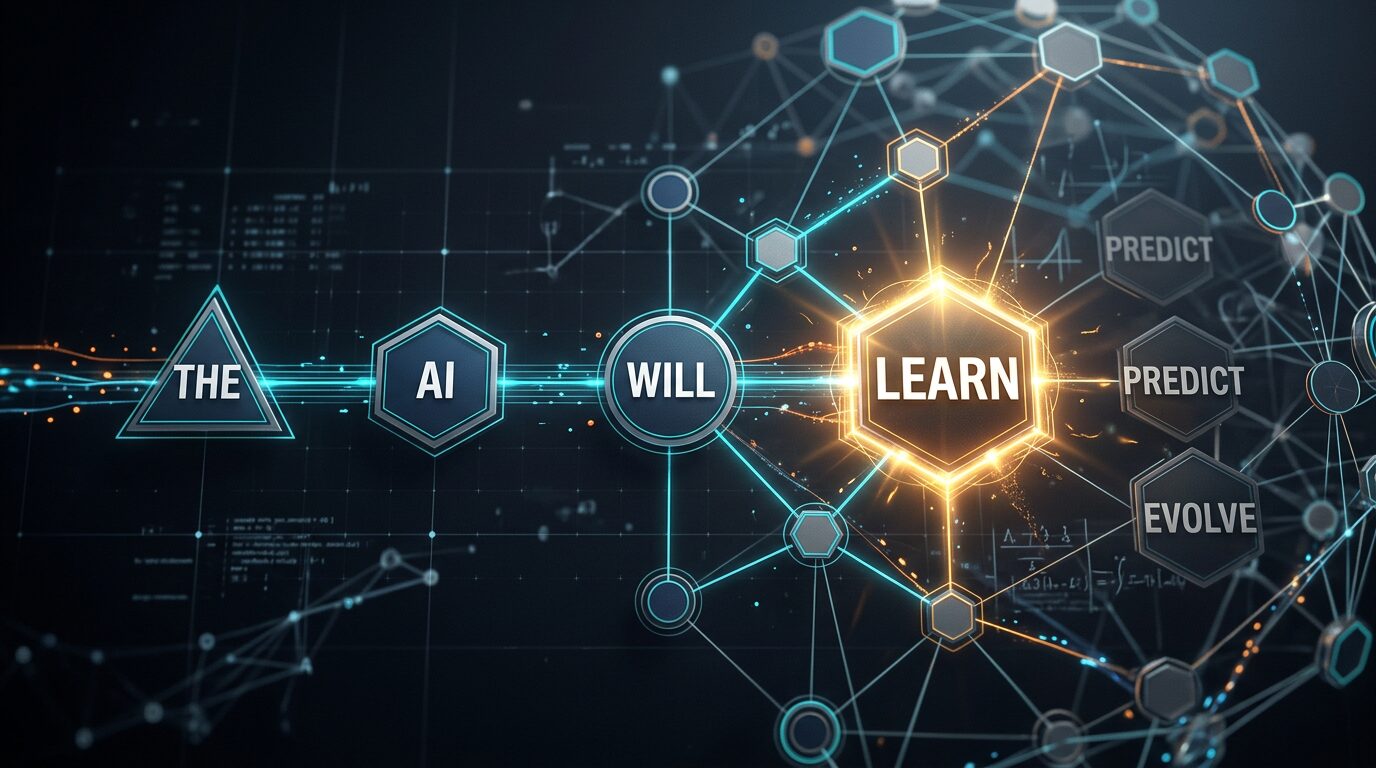
When you type a prompt, the model breaks your text into small pieces called tokens. A token is roughly a word or part of a word. The word “marketing” might be one token; an unusual word might be split into several. The model does not see letters or meaning the way you do. It sees tokens turned into numbers, and it works entirely in the world of those numbers.
What the model learned, from training on an enormous amount of text, is which tokens tend to follow which other tokens. That is it. When it generates an answer, it is repeatedly predicting the most likely next token given everything that came before, one piece at a time, until the response is complete. The fluent paragraph you read is the result of thousands of these next-token predictions stacked together.
Prediction, not retrieval
This is the difference that matters. The model is not pulling a stored fact off a shelf and showing it to you. It is producing the most statistically plausible continuation of your prompt. Most of the time, plausible and true line up, because true statements were common in the training data. But the model has no separate sense of whether what it is saying is correct. It is optimizing for what sounds right, not for what is right.
That is why it can tell you, in the same calm tone, both an accurate statistic and a completely invented one. To the model, they are the same kind of thing: likely-sounding sequences of tokens. It is also why these systems “hallucinate,” producing fluent, confident, and entirely false information. They are not malfunctioning when they do this. They are doing exactly what they were built to do, which is generate plausible text.
OpenAI, which makes ChatGPT, has acknowledged this directly, explaining that the way models are trained and tested rewards confident guessing over admitting uncertainty. The tool learns to bluff because, on the tests used to build it, a confident guess scores better than an honest “I do not know.”
A familiar comparison
You already use a simpler version of this technology every day. When your phone suggests the next word as you text, it is predicting a likely continuation from patterns. A large language model is that same idea scaled up almost unimaginably, trained on far more text and able to track far more context, but the core move is identical: given what came before, what is the most probable next piece? Your phone’s autocomplete is not consulting a database of true facts about your life. Neither is the chatbot. It is just vastly better at sounding like it is.
Why this changes how you use it
Once you internalize prediction-not-retrieval, the professional rules stop feeling like arbitrary caution and start feeling obvious.
You verify factual claims, because the model has no built-in fact-checker. You are it.
You provide context and examples in your prompt, because the model works from patterns, and better input patterns produce better output patterns.
You stay skeptical of confidence, because confidence is just the model’s default tone, not a signal of accuracy.
And you understand why these tools are strongest as a thinking partner and a drafting assistant, and weakest as an oracle. They are extraordinary at producing fluent language and recombining ideas. They are unreliable as a source of truth you have not checked.
The one-sentence version to remember
When someone asks you how AI works, skip the jargon and say this: it predicts the next word based on patterns, it does not look up facts, and that is exactly why you always check it. That single sentence will put you ahead of most people in any workplace, including plenty who have used these tools for years without understanding what they are.
What this does not mean
None of this means AI is dumb or that you should avoid it. Prediction at this scale is astonishingly powerful. These models can restructure a messy document, explain a hard concept three different ways, draft in seconds what would have taken you an hour, and surface connections you would not have thought of. The point is not to distrust the tool. It is to use it for what it is genuinely good at, generating and reshaping language, while staying the human who supplies the facts, the judgment, and the final check. Respect the capability and understand the limits, and you get the best of it without being fooled by it.
You do not need to understand the math to use AI well. You need to understand the nature of the thing: it is a prediction engine that produces plausible language, not a knowledge engine that reports verified facts. Hold that one idea, and every other skill, from writing a sharp brief to knowing when to trust the output, finally has something solid to stand on.