A consulting giant handed a government a report full of sources that did not exist. Here is how it happens, and the three-question habit that prevents it.
In 2025, one of the largest consulting firms on earth delivered a government report it had been paid roughly 440,000 Australian dollars to produce, and one careful reader took it apart. The report, prepared for Australia’s Department of Employment and Workplace Relations, cited academic works that did not exist and a quote attributed to a federal court judgment that was never made. A law researcher at the University of Sydney, Chris Rudge, flagged the fabricated references publicly. Deloitte later issued a partial refund and disclosed that it had used a generative AI system to help produce it.
Then it happened again. Within months, a separate Deloitte report for a Canadian government body, reportedly worth around 1.6 million dollars, was found to contain fabricated citations as well, including papers that could not be located and real researchers credited with work they never produced.
For a student about to enter a profession where your credibility is your currency, this is the story to internalize. These were not amateurs. They were experienced professionals at a respected firm, and the failure was not using AI. It was trusting the output without checking it.
How a fake citation gets born
To prevent the mistake, you have to understand why an AI makes it. A large language model does not look up facts in a database. It predicts likely text based on patterns it learned during training. A citation is just a pattern: an author name, a title, a journal, a year, formatted a certain way. When the model does not have a real source that fits, it can generate one that looks flawless and is entirely invented. This is what people mean by a hallucination. It is not the AI lying. It is the AI doing exactly what it does, which is producing plausible text, with no built-in sense of whether the text is true.
One of the clearest examples from the Deloitte case involved a real law professor whose genuine book was reinvented under a title she had never used. The author was real. The topic was believable. The book did not exist. That is the signature of a fabricated citation, and it is why these errors slip through.
Why smart people miss it
Fabricated citations get past reviewers because they are specific and realistic. The author sounds real. The title is plausible. The formatting is correct. Nothing about a hallucinated reference looks wrong at a glance, and a glance is usually all a busy professional gives it. The more authoritative the surrounding document feels, the less anyone questions the footnotes. That is the trap. The polish of the deliverable buys the errors a free pass.
This matters far beyond consulting. The same mechanism produces a made-up statistic in a marketing report, a misattributed quote in a press release, an invented study in a pitch, or a fake precedent in a legal brief. Any time AI hands you a source, you are one unchecked footnote away from the position Deloitte ended up in.
Picture the early-career version. You are an intern building a market-sizing slide for a new business pitch. You ask an AI for supporting research, and it returns a tidy paragraph anchored by a named industry report with a specific growth figure. It looks authoritative, so it goes on the slide. In the meeting, a partner who knows the space asks which report that figure came from. The honest answer is that you never confirmed the report exists. In a room where your judgment is being evaluated, that is a worse outcome than having no figure at all. The fabricated source did not just create a factual error. It put your reliability in question.
The three-question verification routine
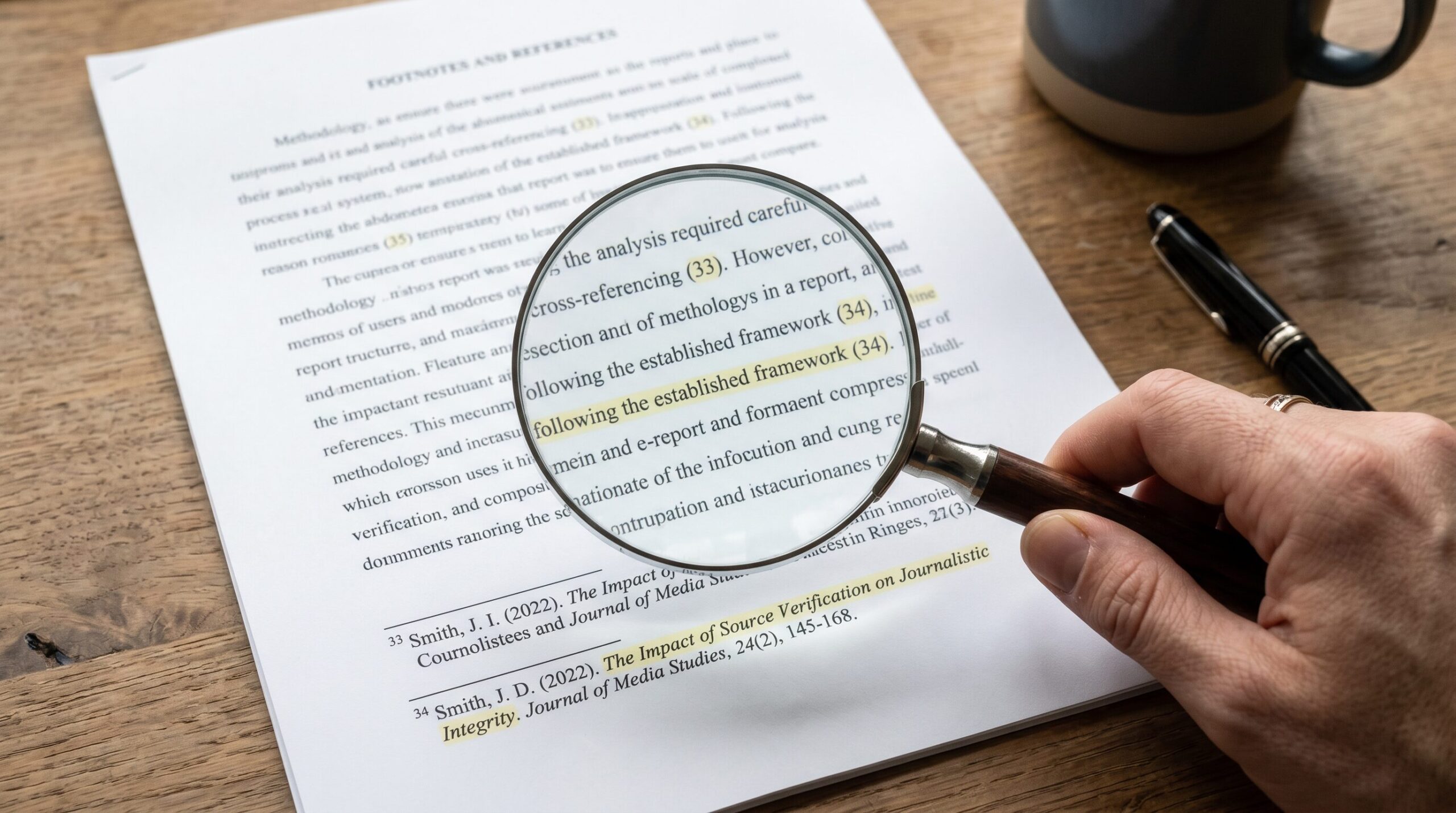
You do not need a research degree to catch this. You need a habit. For every source an AI hands you, ask three questions before it goes anywhere near a finished document.
First, does it exist? Search for the title, the author, and the publication independently. If you cannot find it in a normal search or a library database, treat it as fabricated until proven otherwise. Real sources are findable. Invented ones are not.
Second, does it actually say what the draft claims? A source can be real and still be misused. Open it and confirm that the content genuinely supports the point being made, rather than assuming the AI summarized it correctly. Models routinely attach a real-sounding source to a claim that source never made.
Third, did the named author actually write it? Real authors get attached to fake papers, and real papers get attached to the wrong authors. A quick check of the author’s actual body of work closes this gap.
Three questions, a couple of minutes, and you have eliminated the single most common and most damaging AI error in professional writing.
The part that made it worse
Notice how the Deloitte story surfaced. The AI use came to light because the errors were caught, not because the firm flagged it up front. Verification and transparency travel together. If you checked the output and you are open about how the work was produced, a caught error is a normal part of doing the work. If neither happened, a single diligent reader can turn your deliverable into a headline. The cheap insurance is to verify first and be straightforward about your process.
A fabricated citation takes a couple of minutes to catch and a reputation to ignore. Build the three-question habit now, while the stakes are a class assignment or an internship, so it is automatic by the time the stakes are a client, a manager, or your byline. It is the same lesson a lawyer learned the hard way: the people who get burned are not the ones who used AI, but the ones who forgot they were still responsible for the output.